4 · Elastostatics as a Minimization Problem#
Posing an elastic object is an optimization: find the vertex positions \(x\) that minimize
We pin part of the shape, drag a handle, and let everything else settle. The pin and handle terms are quadratic spring penalties. We minimize silently with Newton (the solver is tutorial 5’s job) and focus on how different energies pose differently.
%matplotlib inline
import numpy as np
import matplotlib.pyplot as plt
import simkit
from simkit.solvers import newton_solver
import utils
A small, readable simulator#
ElasticPose is our first simulator class. It composes three energy terms from
utils — the elastic material, a fixed pin spring, and a movable
handle spring — and exposes energy / gradient / hessian that sum
those terms one per line, exactly as the Newton solver wants them. Every
later tutorial builds its simulator the same way.
class ElasticPose:
    """Minimize  elastic(x) + pin spring + handle spring  with Newton."""

    def __init__(self, X, T, material="Neo-Hookean", K=1e5):
        self.p   = utils.precompute(X, T, mu=1.0, lam=1.0)   # J, vol, masses, ...
        self.psi = utils.make_material(material)             # elastic term
        self.pin    = utils.PenaltySpring(self.p.n, self.p.dim, K)
        self.handle = utils.PenaltySpring(self.p.n, self.p.dim, K)

    def set_pin(self, idx, targets):    self.pin.set(idx, targets);    return self
    def set_handle(self, idx, targets): self.handle.set(idx, targets); return self

    def energy(self, x):
        E_elastic = self.psi.energy(x, self.p)
        E_pin     = self.pin.energy(x)
        E_handle  = self.handle.energy(x)
        return E_elastic + E_pin + E_handle

    def gradient(self, x):
        g_elastic = self.psi.gradient(x, self.p)
        g_pin     = self.pin.gradient(x)
        g_handle  = self.handle.gradient(x)
        return g_elastic + g_pin + g_handle

    def hessian(self, x):
        H_elastic = self.psi.hessian(x, self.p)
        H_pin     = self.pin.hessian(x)
        H_handle  = self.handle.hessian(x)
        return H_elastic + H_pin + H_handle

    def solve(self, U0, iters=30):
        x = newton_solver(U0.reshape(-1, 1), self.energy, self.gradient, self.hessian,
                          max_iter=iters, do_line_search=True)
        return x.reshape(self.p.n, self.p.dim)
A triangle: pin the left vertex, swing the right one in a figure-8#
The pinned vertex stays put while the handle traces a figure-8 (a lemniscate), so the free apex both stretches and compresses. We step the pose explicitly: at each handle position we re-aim the handle and re-solve, starting each solve from the previous equilibrium.
X = np.array([[-0.5, 0.0], [0.5, 0.0], [0.0, np.sqrt(3) / 2]])
T = np.array([[0, 1, 2]])
PIN, HANDLE = 0, 1

# figure-8 (lemniscate) traced by the handle, starting from rest (t=0 -> no offset)
t = np.linspace(0, 2 * np.pi, 48)
handle_path = X[HANDLE] + np.stack([0.45 * np.sin(t), 0.6 * np.sin(2 * t)], axis=1)

pose = ElasticPose(X, T, "Neo-Hookean").set_pin(PIN, X[PIN])
states = []
U = X.copy()
for h in handle_path:
    pose.set_handle(HANDLE, h)
    U = pose.solve(U)
    states.append(U.copy())

fig, anim = utils.animate_mesh(states, T, lims=((-1.2, 1.6), (-1.2, 1.2)),
    title="Neo-Hookean triangle: handle traces a figure-8",
    pin_pts=X[[PIN]], handle_traj=[s[HANDLE] for s in states],
    target_pts=list(handle_path), fps=20, figsize=(6, 5))
utils.show_video(fig, anim, "media/04_triangle.mp4", fps=20)
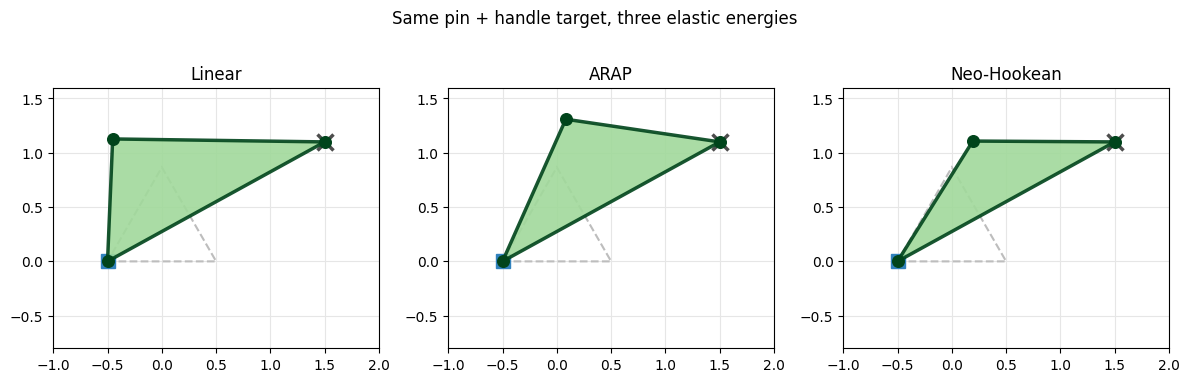
Same handle, three energies, very different poses#
Pull the handle far up-and-right and compare where the free apex lands under each
model. Linear elasticity (no rotation-invariance) reacts quite differently from
ARAP and Neo-Hookean. We loop over the three materials explicitly, building a
fresh ElasticPose for each.
target = np.array([1.5, 1.1])
fig, axes = plt.subplots(1, 3, figsize=(12, 4))
for ax, material in zip(axes, ["Linear", "ARAP", "Neo-Hookean"]):
    pose = ElasticPose(X, T, material).set_pin(PIN, X[PIN]).set_handle(HANDLE, target)
    U = pose.solve(X.copy())
    utils.setup_axes(ax, (-1.0, 2.0), (-0.8, 1.6), title=material)
    utils.TriangleArtist(ax, U, rest=X)
    ax.plot(*X[PIN], "s", color=utils.PIN_C, ms=10)
    ax.plot(*target, "x", color="0.3", ms=12, mew=2.5)
fig.suptitle("Same pin + handle target, three elastic energies")
fig.tight_layout(); plt.show()
A cantilever beam: pin the left edge, swing the whole right edge#
The handle is now every vertex on the right edge (not one). We rotate those target points about the origin — the orange handles swing up and down in a wide arc — which whips the beam through large bends. Starting from rest, the angle sweeps to about \(\pm 120^\circ\) and back. Targets are marked with an ×.
Xb, Tb = utils.triangulated_grid(nx=16, ny=5, width=2.0, height=0.4)
pin_idx   = np.where(Xb[:, 0] <= Xb[:, 0].min() + 1e-6)[0]
right_idx = np.where(Xb[:, 0] >= Xb[:, 0].max() - 1e-6)[0]

def rotate_about_origin(P, theta):
    R = np.array([[np.cos(theta), -np.sin(theta)], [np.sin(theta), np.cos(theta)]])
    return P @ R.T

# angle swings +/-120 deg from rest and back
angles = np.deg2rad(120) * np.sin(np.linspace(0, 2 * np.pi, 48))

beam = ElasticPose(Xb, Tb, "Neo-Hookean").set_pin(pin_idx, Xb[pin_idx])
states, targets = [], []
U = Xb.copy()
for th in angles:
    tgt = rotate_about_origin(Xb[right_idx], th)
    beam.set_handle(right_idx, tgt)
    U = beam.solve(U)
    states.append(U.copy())
    targets.append(tgt.copy())

fig, anim = utils.animate_mesh(states, Tb, lims=((-1.8, 1.8), (-1.8, 1.8)),
    title="Cantilever: right edge swung in an arc about the origin",
    pin_pts=Xb[pin_idx], handle_traj=[s[right_idx] for s in states],
    target_pts=targets, fps=20, figsize=(6, 6))
utils.show_video(fig, anim, "media/04_beam.mp4", fps=20)
Takeaways#
Posing = minimizing elastic energy + soft pin/handle springs.
The same setup with a different energy gives a different equilibrium.
We solved it silently with Newton. How that solve works is next.