16 · Mass-Spring Actuation: Pulling Surface Tendons to Steer a Beam#
The previous tutorial built a soft actuator out of a sealed pneumatic chamber — pump area in, the wall pushes outward, the beam bends. This notebook tells the same story with a different actuator: contractile springs glued to the surface of the beam, like tendons or artificial muscles.
A single spring (tutorial 11) stores \(\tfrac12 k\,(\lVert x_j-x_i\rVert - l_0)^2\) and pulls its endpoints toward its rest length \(l_0\). A real tendon actuates by shortening its own rest length: drop \(l_0\) and the spring contracts, dragging whatever it is attached to. We bolt two such springs onto a neo-Hookean beam — one along the top surface, one along the bottom — and command their rest lengths.
with \(l(x)=\lVert x_j-x_i\rVert\) the current length and \(l_0^\star\) the commanded rest length. Its gradient \(k\,(l-l_0^\star)\,\nabla l\) is a force of magnitude \(k(l-l_0^\star)\) pulling the two endpoints together along the edge — Hooke’s law. Coupling it to a nonlinear neo-Hookean elastic beam (full-order FEM, no subspace) and pinning the left wall, we solve the quasistatic equilibrium
at every step of a slowly shortening rest length. Contract the top tendon and the top fibers are dragged together — the cantilever curls up; contract the bottom and it curls down. Drive the two differently and you dial in any deflection angle in between.
%matplotlib inline
import numpy as np
import scipy.sparse as sps
import matplotlib.pyplot as plt
from matplotlib.animation import FuncAnimation

import simkit
from simkit.solvers import newton_solver
import utils

TOP_C     = "#c0392b"   # top tendon
BOT_C     = "#08519c"   # bottom tendon
WALL_FACE = "#cfe8df"   # beam fill
WALL_EDGE = "#2a7f62"   # beam mesh edges
PIN_C     = "#3182bd"   # pinned-wall markers
NODE_C    = "#e6550d"   # tendon endpoints
A beam with two surface tendons#
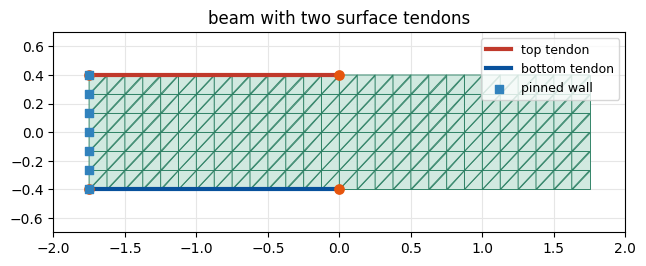
We mesh the beam as a structured triangle grid so its corners and mid-span vertices are easy to name. Two actuator springs are attached to the surface:
the top tendon runs from the top-left vertex to the top-middle vertex,
the bottom tendon runs from the bottom-left vertex to the bottom-middle vertex.
Each spans the left half of the beam, just inboard of the clamped wall — exactly where a tendon has the most leverage to bend a cantilever. Their natural rest length is simply the distance they cover at rest; actuating a tendon means commanding a shorter rest length so it tries to reel its two endpoints in.
def beam_with_tendons(L=3.5, H=0.8, nx=29, ny=7):
    '''Structured triangle-grid beam (L x H). Returns the mesh and the two
    actuator edges E_act = [[top-left, top-mid], [bottom-left, bottom-mid]]
    (row 0 = top tendon, row 1 = bottom tendon).'''
    X, T = utils.triangulated_grid(nx, ny, width=L, height=H)
    mid = nx // 2
    top_left,  top_mid = (ny - 1) * nx + 0, (ny - 1) * nx + mid
    bot_left,  bot_mid = 0,                 mid
    E_act = np.array([[top_left, top_mid], [bot_left, bot_mid]])
    return X, T, E_act


# Build one beam and look at it.
X, T, E_act = beam_with_tendons()
pin_idx = np.where(X[:, 0] <= X[:, 0].min() + 1e-6)[0]
l0_rest = simkit.edge_lengths(X, E_act).reshape(-1, 1)
print(f"mesh: {X.shape[0]} vertices, {T.shape[0]} triangles")
print(f"tendon rest lengths: top {l0_rest[0,0]:.3f},  bottom {l0_rest[1,0]:.3f}")

fig, ax = plt.subplots(figsize=(8, 2.6))
utils.PolyMeshArtist(ax, X, T, facecolor=WALL_FACE, edgecolor=WALL_EDGE, lw=0.7)
for (i, j), c, lbl in zip(E_act, [TOP_C, BOT_C], ["top tendon", "bottom tendon"]):
    ax.plot(X[[i, j], 0], X[[i, j], 1], "-", color=c, lw=3.0, zorder=4, label=lbl)
    ax.scatter(X[[i, j], 0], X[[i, j], 1], s=45, color=NODE_C, zorder=5)
ax.scatter(X[pin_idx, 0], X[pin_idx, 1], s=40, marker="s", color=PIN_C, zorder=5,
           label="pinned wall")
utils.setup_axes(ax, (-2.0, 2.0), (-0.7, 0.7), title="beam with two surface tendons")
ax.legend(loc="upper right", fontsize=9)
plt.show()
mesh: 203 vertices, 336 triangles
tendon rest lengths: top 1.750,  bottom 1.750
The actuation energy#
TendonBeam assembles the three terms of the objective:
Neo-Hookean elasticity — the full-order, nonlinear FEM energy from tutorial 3/4 (
utils.make_material("Neo-Hookean")). Every mesh vertex is a degree of freedom; no reduction.Two tendons — \(\sum_s \tfrac12 k_s (l_s(x)-l_{0,s}^\star)^2\), each a
utils.SpringEnergybuilt from tutorial 11’s stacked edge-difference operator \(J\): it maps the global positions straight to that edge’s vector, so the spring force, Hooke stiffness, and rest-length are exactly the single-spring ones — just scattered onto the right surface DOFs. We keep the top and bottom tendons as two separately-named terms.Pin — a stiff
utils.PenaltySpringclamping the left wall in place.
The commanded rest lengths \(l_{0,s}^\star\) are the control inputs: lowering a
tendon’s l0 makes it contract. For the Hessian we keep the PSD-projected elastic
block plus the PSD-projected spring blocks (utils.SpringEnergy projects
internally): a contracting spring (\(l>l_0^\star\)) is in tension and convex, but
the moment one goes slack the raw spring Hessian turns indefinite, so the
projection keeps Newton positive-definite and robust.
class TendonBeam:
    '''Quasistatic neo-Hookean beam with two contractile surface tendons and a
    pinned wall. Actuate by commanding each tendon's rest length.'''

    def __init__(self, X, T, E_act, E_young=1e4, nu=0.45,
                 ym_spring=2e3, K_pin=1e9):
        self.X, self.T   = X, T
        self.p   = utils.precompute(X, T, ym=E_young, pr=nu)   # J, vol, Lame, ...
        self.n, self.dim = self.p.n, self.p.dim
        self.psi = utils.make_material("Neo-Hookean")          # elastic term

        # --- two surface tendons: one single-edge SpringEnergy each ---
        self.E_act   = E_act
        self.l0_rest = simkit.edge_lengths(X, E_act).reshape(-1, 1)   # natural lengths
        ym_e         = np.full((1, 1), ym_spring)
        vol_e        = np.ones((1, 1))
        E_top, E_bot = E_act[[0]], E_act[[1]]
        J_top = sps.kron(simkit.edge_displacement_jacobian(X, E_top), sps.eye(self.dim)).tocsc()
        J_bot = sps.kron(simkit.edge_displacement_jacobian(X, E_bot), sps.eye(self.dim)).tocsc()
        self.tendon_top = utils.SpringEnergy(J_top, ym_e, vol_e, self.l0_rest[[0]].copy())
        self.tendon_bot = utils.SpringEnergy(J_bot, ym_e, vol_e, self.l0_rest[[1]].copy())

        # --- pin the left wall ---
        self.pin_idx = np.where(X[:, 0] <= X[:, 0].min() + 1e-6)[0]
        self.pin     = utils.PenaltySpring(self.n, self.dim, K_pin).set(self.pin_idx, X[self.pin_idx])

    def command(self, l0_top, l0_bot):
        '''Set the commanded (contracted) rest length of each tendon.'''
        self.tendon_top.l0 = np.array([[l0_top]])
        self.tendon_bot.l0 = np.array([[l0_bot]])

    def tension(self, x):
        '''Per-tendon tension f = k (l - l0*) (positive = pulling in).'''
        l  = simkit.edge_lengths(x.reshape(-1, self.dim), self.E_act).reshape(-1, 1)
        l0 = np.array([self.tendon_top.l0[0, 0], self.tendon_bot.l0[0, 0]]).reshape(-1, 1)
        k  = self.tendon_top.ym[0, 0] / self.l0_rest ** 2
        return (k * (l - l0)).ravel()

    def energy(self, x):
        E_elastic    = self.psi.energy(x, self.p)
        E_tendon_top = self.tendon_top.energy(x)
        E_tendon_bot = self.tendon_bot.energy(x)
        E_pin        = self.pin.energy(x)
        return E_elastic + E_tendon_top + E_tendon_bot + E_pin

    def gradient(self, x):
        g_elastic    = self.psi.gradient(x, self.p)
        g_tendon_top = self.tendon_top.gradient(x)
        g_tendon_bot = self.tendon_bot.gradient(x)
        g_pin        = self.pin.gradient(x)
        return g_elastic + g_tendon_top + g_tendon_bot + g_pin

    def hessian(self, x):
        H_elastic    = self.psi.hessian(x, self.p)
        H_tendon_top = self.tendon_top.hessian(x)
        H_tendon_bot = self.tendon_bot.hessian(x)
        H_pin        = self.pin.hessian(x)
        return (H_elastic + H_tendon_top + H_tendon_bot + H_pin).tocsc()

    def contract_to(self, l0_top, l0_bot, U0, iters=40):
        '''Quasistatic Newton solve at fixed commanded rest lengths.'''
        self.command(l0_top, l0_bot)
        x = newton_solver(U0.reshape(-1, 1), self.energy, self.gradient, self.hessian,
                          max_iter=iters, do_line_search=True)
        return x.reshape(self.n, self.dim)
Quasistatically contracting the tendons#
There is no time, mass, or velocity here — this is quasistatic. We ramp each tendon’s commanded rest length from its natural value down toward a target fraction, and at each step re-solve for static equilibrium with Newton, warm-starting from the previous pose. Each frame is the beam holding still at the current actuation, so the animation reads as a muscle slowly contracting.
def actuate(beam, top_ratio=1.0, bot_ratio=1.0, n_steps=28):
    '''Ramp the top/bottom commanded rest lengths to (ratio x natural), solving
    each step. Returns the poses, per-tendon lengths, and tensions.'''
    l0_top0, l0_bot0 = beam.l0_rest[0, 0], beam.l0_rest[1, 0]
    U = beam.X.copy()
    states, lengths, tens = [U.copy()], [beam.l0_rest.ravel().copy()], [np.zeros(2)]
    for s in np.linspace(0, 1, n_steps)[1:]:
        l0_top = l0_top0 * (1 + s * (top_ratio - 1))
        l0_bot = l0_bot0 * (1 + s * (bot_ratio - 1))
        U = beam.contract_to(l0_top, l0_bot, U)
        states.append(U.copy())
        lengths.append(simkit.edge_lengths(U, beam.E_act))
        tens.append(beam.tension(U.reshape(-1, 1)))
    return np.array(states), np.array(lengths), np.array(tens)


def tip_angle(beam, U):
    '''Deflection angle (deg) of the cantilever tip relative to rest.'''
    tip = np.where(beam.X[:, 0] >= beam.X[:, 0].max() - 1e-6)[0]
    dy  = U[tip, 1].mean() - beam.X[tip, 1].mean()
    span = beam.X[:, 0].max() - beam.X[:, 0].min()
    return np.degrees(np.arctan2(dy, span))


def animate_actuation(beam, states, angles, *, title="", fps=18):
    '''Left: the beam bending as its tendons contract (tendons drawn on top).
    Right: tip deflection angle vs actuation. Returns (fig, anim).'''
    xs = np.linspace(0, 100, len(states))                       # actuation %
    xlim, ylim = utils.auto_limits(states, pad=0.25)

    fig, (axL, axR) = plt.subplots(1, 2, figsize=(12, 4.2),
                                   gridspec_kw={"width_ratios": [2.4, 1]})
    utils.setup_axes(axL, xlim, ylim, title=title)
    mesh = utils.PolyMeshArtist(axL, states[0], beam.T, facecolor=WALL_FACE,
                                edgecolor=WALL_EDGE, lw=0.7)
    tendons = []
    for (i, j), c in zip(beam.E_act, [TOP_C, BOT_C]):
        (ln,) = axL.plot([], [], "-", color=c, lw=3.0, zorder=4)
        tendons.append((ln, i, j))
    (nodes,) = axL.plot([], [], "o", color=NODE_C, ms=6, zorder=5)
    axL.scatter(beam.X[beam.pin_idx, 0], beam.X[beam.pin_idx, 1], s=35, marker="s",
                color=PIN_C, zorder=5)

    trace = utils.TracePlot(axR, xs, {"tip angle": angles}, colors={"tip angle": "#444"},
                            xlabel="actuation  (%)", ylabel="tip deflection angle  (deg)",
                            title="angle vs. actuation")
    axR.axhline(0, color="0.6", lw=1.0)

    def update(i):
        U = states[i]
        mesh.update(U)
        ends = []
        for ln, a, b in tendons:
            ln.set_data(U[[a, b], 0], U[[a, b], 1])
            ends += [a, b]
        nodes.set_data(U[ends, 0], U[ends, 1])
        trace.update(i)
        return ()

    anim = FuncAnimation(fig, update, frames=len(states), interval=1000 / fps, blit=False)
    return fig, anim


# Contract the TOP tendon to 40% of its rest length -> cantilever curls up.
X, T, E_act = beam_with_tendons()
beam = TendonBeam(X, T, E_act)
states, lengths, tens = actuate(beam, top_ratio=0.4, bot_ratio=1.0)
angles = np.array([tip_angle(beam, U) for U in states])
print(f"top tendon length {lengths[0,0]:.3f} -> {lengths[-1,0]:.3f}")
print(f"tip deflection angle: {angles[-1]:+.1f} deg")
print(f"peak top-tendon tension f = {tens[:,0].max():.1f}")

fig, anim = animate_actuation(beam, states, angles, title="contract top tendon -> beam curls up")
utils.show_video(fig, anim, "media/16_tendon_contract.mp4", fps=18)
top tendon length 1.750 -> 0.934
tip deflection angle: +35.5 deg
peak top-tendon tension f = 213.0
Steering: which tendon you pull sets the bend#
The two tendons are the actuator’s control inputs. Contract the top one and the top fibers are reeled in — the beam curls up. Contract the bottom one and it curls down. Contract both equally and the pulls are symmetric: the beam shortens but barely bends. We run the same quasistatic contraction for three actuation patterns and play them side by side.
designs = [
    ("contract top  ->  curls up",     0.4, 1.0),
    ("contract both  ->  no net bend", 0.4, 0.4),
    ("contract bottom  ->  curls down", 1.0, 0.4),
]

panels = []
for label, tr, br in designs:
    bd = TendonBeam(X, T, E_act)
    sd, _, _ = actuate(bd, top_ratio=tr, bot_ratio=br)
    panels.append({"states": sd, "T": T, "title": label, "E_act": E_act,
                   "ratios": (tr, br)})
    print(f"{label:34s}  tip angle = {tip_angle(bd, sd[-1]):+.1f} deg")


def animate_beams_grid(panels, *, lims, fps=18, suptitle=None):
    '''Several tendon-beams side by side, tendons overlaid, played in sync.'''
    npan = len(panels)
    fig, axes = plt.subplots(1, npan, figsize=(4.6 * npan, 4.0), squeeze=False)
    axes = axes[0]
    nframes = max(len(p["states"]) for p in panels)
    arts = []
    for ax, p in zip(axes, panels):
        utils.setup_axes(ax, lims[0], lims[1], title=p["title"])
        mesh = utils.PolyMeshArtist(ax, p["states"][0], p["T"], facecolor=WALL_FACE,
                                    edgecolor=WALL_EDGE, lw=0.6)
        lns = []
        for (i, j), c in zip(p["E_act"], [TOP_C, BOT_C]):
            (ln,) = ax.plot([], [], "-", color=c, lw=2.6, zorder=4)
            lns.append((ln, i, j))
        ax.scatter(X[pin_idx, 0], X[pin_idx, 1], s=30, marker="s", color=PIN_C, zorder=5)
        arts.append((mesh, lns))

    def update(k):
        for (mesh, lns), p in zip(arts, panels):
            U = p["states"][min(k, len(p["states"]) - 1)]
            mesh.update(U)
            for ln, a, b in lns:
                ln.set_data(U[[a, b], 0], U[[a, b], 1])
        return ()

    anim = FuncAnimation(fig, update, frames=nframes, interval=1000 / fps, blit=False)
    if suptitle:
        fig.suptitle(suptitle)
    return fig, anim


fig, anim = animate_beams_grid(panels, lims=((-2.05, 2.05), (-1.6, 1.6)),
                               fps=18, suptitle="same contraction, three tendon patterns")
utils.show_video(fig, anim, "media/16_tendon_steering.mp4", fps=18)
contract top -> curls up tip angle = +35.5 deg
contract both -> no net bend tip angle = -3.4 deg
contract bottom -> curls down tip angle = -34.9 deg
A deflection gallery#
Holding the total contraction fixed and sliding it from the bottom tendon to the top one sweeps out a fan of deflection angles — continuous steering authority from a single differential knob. We parametrize it by an asymmetry \(d\in[-0.4,\,0.4]\): the top tendon is commanded to \((1+d)\times\) its rest length and the bottom to \((1-d)\times\). \(d<0\) shortens the top (curls up), \(d>0\) shortens the bottom (curls down), \(d=0\) is the rest beam. Each fully-actuated pose is overlaid on its rest shape (grey) and labeled with the tip angle.
asyms = [-0.4, -0.2, 0.0, 0.2, 0.4]
fig, axes = plt.subplots(1, len(asyms), figsize=(3.0 * len(asyms), 2.8), squeeze=False)
for ax, d in zip(axes[0], asyms):
    bg = TendonBeam(X, T, E_act)
    sg, _, _ = actuate(bg, top_ratio=1 + d, bot_ratio=1 - d)
    U   = sg[-1]
    ang = tip_angle(bg, U)
    utils.PolyMeshArtist(ax, X, T, facecolor="none", edgecolor="0.8", lw=0.5)     # rest ghost
    utils.PolyMeshArtist(ax, U, T, facecolor=WALL_FACE, edgecolor=WALL_EDGE, lw=0.5)
    for (i, j), c in zip(E_act, [TOP_C, BOT_C]):
        ax.plot(U[[i, j], 0], U[[i, j], 1], "-", color=c, lw=2.4, zorder=4)
    ax.scatter(X[pin_idx, 0], X[pin_idx, 1], s=16, marker="s", color=PIN_C, zorder=5)
    utils.setup_axes(ax, (-2.0, 2.2), (-1.6, 1.6),
                     title=f"top x{1+d:.1f} / bot x{1-d:.1f}\ntip angle {ang:+.0f} deg",
                     grid=False)
fig.suptitle("differential tendon contraction steers the tip deflection angle")
fig.tight_layout()
fig.savefig("media/16_tendon_gallery.png", dpi=130, bbox_inches="tight")
plt.show()

Takeaways#
A contractile tendon is just a spring whose rest length you command: penalizing \(\tfrac12 k (l(x)-l_0^\star)^2\) and lowering \(l_0^\star\) pulls its two endpoints together, and its gradient \(k(l-l_0^\star)\nabla l\) is a genuine Hooke force along the edge (tutorial 11).
Glued to the surface of a nonlinear neo-Hookean full-order beam and a pinned wall, ramping the rest lengths and re-solving with Newton gives a clean quasistatic actuation — the same recipe as the pneumatic chamber, with an off-center spring in place of an off-center chamber.
The raw spring Hessian goes indefinite when a tendon slackens; the PSD-projected block keeps the solve positive-definite and robust.
Where and how hard you pull is steering: a top tendon curls the cantilever up, a bottom one curls it down, and the differential contraction sets the deflection angle. Real soft robots and tendon-driven fingers chain many such actuators to reach, grip, and crawl.