15 · Pneumatic Actuation: Inflating a Chamber to Steer a Beam#
The previous tutorials posed an elastic object by pulling on it with handle springs (tutorial 4) and measured the signed area enclosed by a closed mesh outline (tutorial 13). This notebook bolts the two ideas together to build a soft pneumatic actuator.
A pneumatic actuator is a soft body with a sealed chamber. Pump fluid in, the chamber wants to enclose more area, and the surrounding material has to deform to make room — the deformation is the actuation. Robots steer by arranging chambers so that inflating them bends the structure a chosen way.
We model the chamber with the signed-area outline energy. If \(A(x)\) is the area the chamber outline encloses and \(A^\star\) is the area we are commanding it to,
Its gradient is \(k\,(A-A^\star)\,\nabla A\). The shoelace gradient \(\nabla A\) is the integrated outward normal of the chamber wall, so this force pushes every wall vertex outward — exactly a pressure load, with \(p = k\,(A^\star - A)\) playing the role of internal pressure. We couple it to a nonlinear neo-Hookean elastic energy (full-order FEM, no subspace) and solve the quasistatic equilibrium
at every step of a slowly rising target area \(A^\star\). Pinning the left edge turns the beam into a cantilever; an off-center chamber inflates asymmetrically and curls the cantilever up or down.
%matplotlib inline
import numpy as np
import scipy.sparse as sps
import matplotlib.pyplot as plt
from matplotlib.animation import FuncAnimation

# igl's Triangle wrapper meshes a rectangle with an elliptical hole punched out.
import igl
import igl.triangle

import simkit
from simkit.solvers import newton_solver
import utils

CHAMBER_C = "#08519c"   # chamber outline
WALL_FACE = "#cfe8df"   # beam fill
WALL_EDGE = "#2a7f62"   # beam mesh edges
PIN_C     = "#3182bd"   # pinned-wall markers
A beam with a chamber punched out#
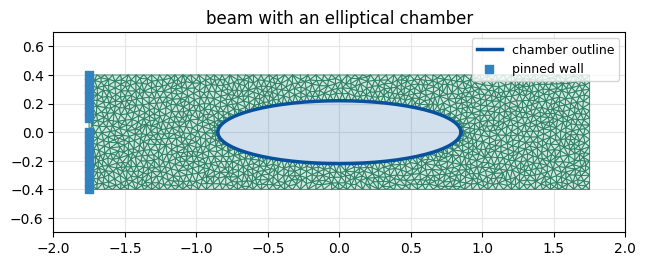
We triangulate a rectangular beam with a single elliptical chamber removed from its interior. The outer rectangle and the inner ellipse are handed to Triangle as boundary segments; a hole point placed at the ellipse center tells Triangle to leave that pocket empty.
chamber_outline then recovers the chamber wall as a closed edge loop. The mesh
has two boundary loops — the outer rectangle and the inner ellipse —
and the chamber is simply the one with the smaller bounding box. That edge loop
is precisely what tutorial 13’s outline_areas consumes, so the chamber’s
enclosed area is differentiable in the mesh vertices.
def beam_with_chamber(L=3.5, H=0.8, cx=0.0, cy=0.0, a=0.85, b=0.22,
                      n_chamber=128, max_area=0.0012):
    """Triangulate a rectangular beam (L x H) with one elliptical chamber
    (semi-axes a, b, centered at (cx, cy)) punched out of it. The chamber must
    fit strictly inside the beam (a thin wall is fine; touching the boundary is
    not) so that the mesh keeps a clean inner loop to inflate."""
    assert abs(cy) + b < H / 2 - 1e-3 and abs(cx) + a < L / 2, "chamber escapes the beam"
    rect   = np.array([[-L/2, -H/2], [L/2, -H/2], [L/2, H/2], [-L/2, H/2]])
    E_rect = np.array([[0, 1], [1, 2], [2, 3], [3, 0]])

    t   = np.linspace(0, 2 * np.pi, n_chamber, endpoint=False)
    ell = np.stack([cx + a * np.cos(t), cy + b * np.sin(t)], axis=1)
    E_ell = np.stack([np.arange(n_chamber), np.roll(np.arange(n_chamber), -1)], axis=1) + 4

    V = np.vstack([rect, ell])
    E = np.vstack([E_rect, E_ell])
    # q: quality, a<area>: max triangle area, Q: quiet. H marks the hole.
    X, T, _, _, _ = igl.triangle.triangulate(V, E, H=np.array([[cx, cy]]),
                                             flags=f"qa{max_area}Q")
    return X, T


def chamber_outline(X, T):
    """Closed edge loop of the punched-out chamber (the inner boundary)."""
    loops = igl.boundary_loop_all(T)
    diag  = [np.linalg.norm(X[l].max(0) - X[l].min(0)) for l in loops]
    loop  = loops[int(np.argmin(diag))]          # inner loop = smallest bbox
    return np.stack([loop, np.roll(loop, -1)], axis=1)


# Build one beam with a centered chamber and look at it.
X, T = beam_with_chamber(cx=0.0, cy=0.0)
E_chamber = chamber_outline(X, T)
pin_idx   = np.where(X[:, 0] <= X[:, 0].min() + 1e-6)[0]
A_rest    = simkit.outline_areas(X, [E_chamber])[0]
print(f"mesh: {X.shape[0]} vertices, {T.shape[0]} triangles")
print(f"chamber rest area |A| = {abs(A_rest):.3f}   (ellipse pi*a*b = {np.pi*0.85*0.22:.3f})")

fig, ax = plt.subplots(figsize=(8, 2.6))
utils.PolyMeshArtist(ax, X, T, facecolor=WALL_FACE, edgecolor=WALL_EDGE, lw=0.7)
loop = E_chamber[:, 0]
ax.fill(*np.vstack([X[loop], X[loop[0]]]).T, color=CHAMBER_C, alpha=0.18, zorder=3)
ax.plot(*np.vstack([X[loop], X[loop[0]]]).T, "-", color=CHAMBER_C, lw=2.5, zorder=4,
        label="chamber outline")
ax.scatter(X[pin_idx, 0], X[pin_idx, 1], s=40, marker="s", color=PIN_C, zorder=5,
           label="pinned wall")
utils.setup_axes(ax, (-2.0, 2.0), (-0.7, 0.7), title="beam with an elliptical chamber")
ax.legend(loc="upper right", fontsize=9)
plt.show()
mesh: 1601 vertices, 2916 triangles
chamber rest area |A| = 0.587   (ellipse pi*a*b = 0.587)
The pneumatic energy#
PneumaticBeam follows the standard simulator recipe: __init__ calls
utils.precompute once for the per-mesh constants, stores
utils.make_material("Neo-Hookean") as the elastic term, and a
utils.PenaltySpring to clamp the left wall. On top of those two reusable terms
it carries one extra, problem-specific term — the pneumatic chamber.
The objective sums three terms, one per line:
Neo-Hookean elasticity — the full-order, nonlinear FEM energy from tutorial 3/4. No reduction, no subspace: every mesh vertex is a degree of freedom.
Pneumatic chamber — \(\tfrac12 k\,(A(x)-A^\star)^2\). The area, its gradient, and its Hessian come straight from
simkit.outline_areas*. The gradient acts only on the chamber-wall vertices, so we scatter the localoutline_areas_gradient(interleaved[dx0, dy0, ...]) onto those global DOFs.Pin — a stiff
PenaltySpringclamping the left wall in place.
For the Hessian we keep the elastic Hessian (PSD-projected) plus the Gauss-Newton part of the chamber term, \(k\,\nabla A\,\nabla A^{\top}\), a rank-1 PSD update on the wall DOFs. Dropping the indefinite \(k(A-A^\star)\nabla^2 A\) piece keeps the system positive-definite and Newton robust; it vanishes at convergence where \(A \!\approx\! A^\star\) anyway. The quantity \(p = k\,(A^\star - A)\) is the chamber’s internal pressure.
class PneumaticBeam:
    """Quasistatic neo-Hookean beam with one inflatable chamber and a pinned wall."""

    def __init__(self, X, T, E_chamber, E_young=1e4, nu=0.45,
                 k_inflate=1e5, K_pin=1e9):
        self.X, self.T = X, T
        self.p   = utils.precompute(X, T, ym=E_young, pr=nu)   # J, vol, masses, ...
        self.psi = utils.make_material("Neo-Hookean")          # elastic term

        # --- pneumatic chamber (this notebook's own term) ---
        self.E_chamber = E_chamber
        self.verts     = np.unique(E_chamber.ravel())     # chamber-wall vertices
        self.A_rest    = simkit.outline_areas(X, [E_chamber])[0]
        self.k_inflate = k_inflate
        self.A_target  = self.A_rest                       # commanded area (per step)
        # global DOFs of the wall, interleaved [x0, y0, x1, y1, ...] to match
        # the ordering of outline_areas_gradient / outline_areas_hessian.
        self.dofs = np.empty(2 * len(self.verts), dtype=int)
        self.dofs[0::2] = 2 * self.verts
        self.dofs[1::2] = 2 * self.verts + 1

        # --- pin the left wall ---
        self.pin_idx = np.where(X[:, 0] <= X[:, 0].min() + 1e-6)[0]
        self.pin = utils.PenaltySpring(self.p.n, self.p.dim, K_pin).set(self.pin_idx, X[self.pin_idx])

    def pressure(self, x):
        A = simkit.outline_areas(x.reshape(-1, self.p.dim), [self.E_chamber])[0]
        return self.k_inflate * (self.A_target - A)

    # --- the pneumatic chamber term: 1/2 k (A - A*)^2 on the wall DOFs ---
    def E_pneumatic(self, x):
        A = simkit.outline_areas(x.reshape(-1, self.p.dim), [self.E_chamber])[0]
        return 0.5 * self.k_inflate * (A - self.A_target) ** 2

    def g_pneumatic(self, x):
        xn = x.reshape(-1, self.p.dim)
        A  = simkit.outline_areas(xn, [self.E_chamber])[0]
        gA = simkit.outline_areas_gradient(xn, [self.E_chamber])[0].ravel()   # local, interleaved
        g  = np.zeros_like(x)
        g[self.dofs, 0] = self.k_inflate * (A - self.A_target) * gA           # pressure load
        return g

    def H_pneumatic(self, x):
        xn = x.reshape(-1, self.p.dim)
        gA = simkit.outline_areas_gradient(xn, [self.E_chamber])[0].ravel()
        # Gauss-Newton chamber term: k * (dA)(dA)^T on the wall DOFs (rank-1, PSD).
        col = sps.csc_matrix((gA, (self.dofs, np.zeros_like(self.dofs))),
                             shape=(self.p.n * self.p.dim, 1))
        return self.k_inflate * (col @ col.T)

    def energy(self, x):
        E_elastic   = self.psi.energy(x, self.p)
        E_pin       = self.pin.energy(x)
        E_pneumatic = self.E_pneumatic(x)
        return E_elastic + E_pin + E_pneumatic

    def gradient(self, x):
        g_elastic   = self.psi.gradient(x, self.p)
        g_pin       = self.pin.gradient(x)
        g_pneumatic = self.g_pneumatic(x)
        return g_elastic + g_pin + g_pneumatic

    def hessian(self, x):
        H_elastic   = self.psi.hessian(x, self.p)
        H_pin       = self.pin.hessian(x)
        H_pneumatic = self.H_pneumatic(x)
        return (H_elastic + H_pin + H_pneumatic).tocsc()

    def inflate_to(self, A_target, U0, iters=40):
        """Quasistatic Newton solve at a fixed commanded area."""
        self.A_target = A_target
        x = newton_solver(U0.reshape(-1, 1), self.energy, self.gradient, self.hessian,
                          max_iter=iters, do_line_search=True)
        return x.reshape(self.p.n, self.p.dim)
Quasistatically inflating the chamber#
There is no time, mass, or velocity here — this is quasistatic. We ramp
the commanded chamber area \(A^\star\) from its rest value up to growth times
larger, and at each step re-solve for static equilibrium with Newton’s method,
warm-starting from the previous pose. Each frame is the beam holding still at the
current inflation, so the animation reads as a chamber slowly filling up.
def inflate(beam, growth=3.5, n_steps=36):
    """Ramp the commanded chamber area to `growth` x rest, solving each step."""
    U = beam.X.copy()
    states, areas, press = [U.copy()], [beam.A_rest], [0.0]
    for A_t in np.linspace(beam.A_rest, growth * beam.A_rest, n_steps)[1:]:
        U = beam.inflate_to(A_t, U)
        states.append(U.copy())
        areas.append(simkit.outline_areas(U, [beam.E_chamber])[0])
        press.append(beam.pressure(U.reshape(-1, 1)))
    return np.array(states), np.abs(np.array(areas)), np.array(press)


def animate_inflation(beam, states, areas, *, title="", fps=18):
    """Left: the beam deforming as its chamber inflates. Right: chamber area
    filling in. Returns (fig, anim)."""
    loop  = np.append(beam.E_chamber[:, 0], beam.E_chamber[0, 0])   # closed wall loop
    xs    = np.linspace(0, 100, len(states))                        # inflation %
    xlim, ylim = utils.auto_limits(states, pad=0.25)

    fig, (axL, axR) = plt.subplots(1, 2, figsize=(12, 4.2),
                                   gridspec_kw={"width_ratios": [2.4, 1]})
    utils.setup_axes(axL, xlim, ylim, title=title)
    mesh = utils.PolyMeshArtist(axL, states[0], beam.T, facecolor=WALL_FACE,
                                edgecolor=WALL_EDGE, lw=0.7)
    fillholder = {"p": None}
    (wall,) = axL.plot([], [], "-", color=CHAMBER_C, lw=2.5, zorder=4)
    axL.scatter(beam.X[beam.pin_idx, 0], beam.X[beam.pin_idx, 1], s=35, marker="s",
                color=PIN_C, zorder=5)

    trace = utils.TracePlot(axR, xs, {"chamber area": areas}, colors={"chamber area": CHAMBER_C},
                            xlabel="inflation  (%)", ylabel="chamber area  |A|",
                            title="area vs. inflation")

    def update(i):
        mesh.update(states[i])
        wall.set_data(states[i][loop, 0], states[i][loop, 1])
        if fillholder["p"] is not None:
            fillholder["p"].remove()
        fillholder["p"] = axL.fill(states[i][loop, 0], states[i][loop, 1],
                                   color=CHAMBER_C, alpha=0.18, zorder=3)[0]
        trace.update(i)
        return ()

    anim = FuncAnimation(fig, update, frames=len(states), interval=1000 / fps, blit=False)
    return fig, anim


# Off-center (high) chamber: inflating it curls the cantilever downward.
X, T = beam_with_chamber(cy=0.15)
beam = PneumaticBeam(X, T, chamber_outline(X, T))
states, areas, press = inflate(beam)
tip = np.where(X[:, 0] >= X[:, 0].max() - 1e-6)[0]
print(f"area inflated {areas[0]:.3f} -> {areas[-1]:.3f}  (x{areas[-1]/areas[0]:.2f})")
print(f"tip deflection: {states[-1][tip, 1].mean() - X[tip, 1].mean():+.3f}")
print(f"peak chamber pressure |p| = {np.abs(press).max():.1f}")

fig, anim = animate_inflation(beam, states, areas, title="chamber near the top wall -> beam curls down")
utils.show_video(fig, anim, "media/15_pneumatic_inflate.mp4", fps=18)
area inflated 0.587 -> 2.052  (x3.49)
tip deflection: -0.278
peak chamber pressure |p| = 294.8
Steering: where you put the chamber sets the bend#
The chamber position is the actuator’s design knob. Place it above the beam’s neutral axis and the top fibers are forced to stretch more than the bottom ones as it inflates, so the beam curls down. Place it below and the beam curls up. A centered chamber inflates symmetrically and the beam just swells in place — no net bend. We run the same quasistatic inflation for three chamber heights and play them side by side.
designs = [
    ("chamber high  ->  curls down", +0.15),
    ("chamber centered  ->  no bend",  0.00),
    ("chamber low  ->  curls up",     -0.15),
]

panels, finals = [], []
for label, cy in designs:
    Xd, Td = beam_with_chamber(cy=cy)
    bd = PneumaticBeam(Xd, Td, chamber_outline(Xd, Td))
    sd, ad, _ = inflate(bd)
    panels.append({"states": sd, "T": Td, "title": label})
    finals.append((label, bd, sd))
    tipd = np.where(Xd[:, 0] >= Xd[:, 0].max() - 1e-6)[0]
    print(f"{label:32s}  tip dy = {sd[-1][tipd, 1].mean() - Xd[tipd, 1].mean():+.3f}")

fig, anim = utils.animate_meshes_grid(panels, lims=((-2.05, 2.05), (-1.15, 1.15)),
                                      fps=18, suptitle="same inflation, three chamber placements")
utils.show_video(fig, anim, "media/15_pneumatic_steering.mp4", fps=18)
chamber high -> curls down tip dy = -0.278
chamber centered -> no bend tip dy = -0.001
chamber low -> curls up tip dy = +0.278
A deflection gallery#
Sweeping the chamber height through a range of offsets traces out a fan of deflection angles — a continuous steering authority from one design parameter. Below, each fully-inflated final pose is overlaid with its rest shape (grey) and labeled with the tip angle it reaches.
offsets = [+0.15, +0.075, 0.0, -0.075, -0.15]
fig, axes = plt.subplots(1, len(offsets), figsize=(3.0 * len(offsets), 2.8), squeeze=False)
for ax, cy in zip(axes[0], offsets):
    Xg, Tg = beam_with_chamber(cy=cy)
    bg = PneumaticBeam(Xg, Tg, chamber_outline(Xg, Tg))
    sg, _, _ = inflate(bg)
    U = sg[-1]
    loopg = np.append(bg.E_chamber[:, 0], bg.E_chamber[0, 0])
    tipg  = np.where(Xg[:, 0] >= Xg[:, 0].max() - 1e-6)[0]
    dy    = U[tipg, 1].mean() - Xg[tipg, 1].mean()
    ang   = np.degrees(np.arctan2(dy, Xg[:, 0].max() - Xg[:, 0].min()))

    utils.PolyMeshArtist(ax, Xg, Tg, facecolor="none", edgecolor="0.8", lw=0.5)   # rest ghost
    utils.PolyMeshArtist(ax, U, Tg, facecolor=WALL_FACE, edgecolor=WALL_EDGE, lw=0.5)
    ax.fill(U[loopg, 0], U[loopg, 1], color=CHAMBER_C, alpha=0.18, zorder=3)
    ax.scatter(Xg[bg.pin_idx, 0], Xg[bg.pin_idx, 1], s=18, marker="s", color=PIN_C, zorder=5)
    utils.setup_axes(ax, (-2.0, 2.2), (-1.3, 1.3), title=f"cy={cy:+.2f}\ntip angle {ang:+.0f} deg",
                     grid=False)
fig.suptitle("chamber height steers the tip deflection angle")
fig.tight_layout()
fig.savefig("media/15_pneumatic_gallery.png", dpi=130, bbox_inches="tight")
plt.show()

Takeaways#
A sealed chamber is a signed-area outline energy: penalizing \(\tfrac12 k (A(x)-A^\star)^2\) drives the chamber to a commanded area, and its gradient \(k(A-A^\star)\nabla A\) is a genuine pressure load along the wall (the shoelace gradient is the integrated outward normal).
Coupled to nonlinear neo-Hookean full-order FEM and a pinned wall, ramping \(A^\star\) and re-solving with Newton gives a clean quasistatic inflation.
The chamber’s
outline_areasHessian is indefinite; the Gauss-Newton rank-1 part \(k\,\nabla A\,\nabla A^\top\) keeps the solve positive-definite and is exact at equilibrium.Placement is steering: an off-center chamber inflates asymmetrically and bends the cantilever; the offset sets the deflection angle. Real soft robots chain many such chambers to reach, grip, and crawl.